
Why Learning Abacus Math for Children is Important at an Early Age? Parents' Guide
Can you think about such a scene? The scene of a little hand moving colorful wooden beads back and forth while a look of concentration adds more brightness to their face, followed by a big smile on getting the solution. This is what abacus math is all about! It is one of the few educational activities that is actually enjoyable and educational at the same time, which is why it is so popular among children as an after-school activity.
Are you a parent who is thinking of getting your child involved in this kind of math? Here is everything that you need to know in simple words!
For many generations now, parents have been searching for one activity that would provide their children with some sort of an advantage—something that would teach children something useful without making them do it unwillingly. Abacus math does this perfectly!
What Exactly Is Abacus Math?
Abacus, by itself, is an incredibly ancient object—people started making calculators using beads and frames several thousand years ago, way before electronic calculators or computers even came into existence. However, there is no need to be put off by its ancient origin because the abacus is now used in a modern learning technique that helps children feel and see numbers instead of simply looking at them in books.
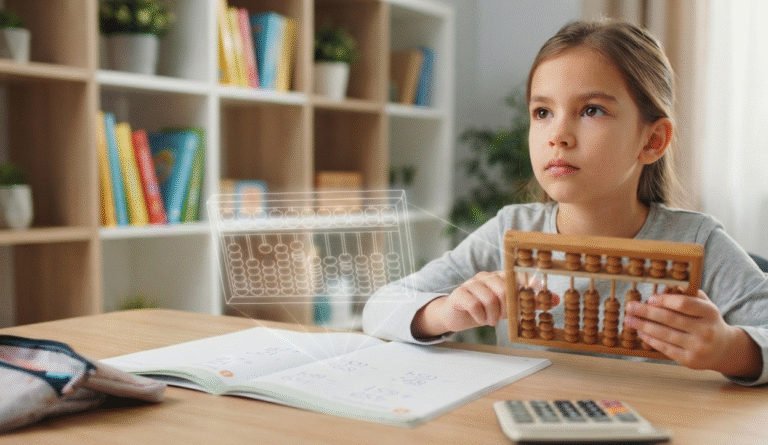
The typical stages of such a process are as follows:
- Step 1 – Moving the beads: The children have to physically move the beads to do addition, subtraction, multiplication, and division processes and make abstract numbers physical.
- Step 2 – Visualizing: With time, children learn to visualize the abacus and imagine themselves moving the beads to solve a certain problem.
- Step 3 – Doing all of this mentally: In the end, children learn to do complex calculations mentally without any help of tools whatsoever.
Visualization is the name of this picture-making ability, and it is indeed the true magic behind the wonders of abacus learning. It is the very same mental power that athletes harness when visualizing the successful performance of a certain shot before making it and the power that musicians leverage by ‘listening’ to the composition before actually performing any notes—yet incredibly, visualization skills can be acquired and developed by kids at an early age just by means of fun exercises with beads.
What makes this process so exciting for both children and their parents is its tangible nature: within just a couple of months of training, a kid who previously had to use both hands and his or her full attention for counting and adding simple numbers becomes capable of solving multi-digit calculations at an incredible speed, sometimes even outperforming calculators!
Why Early Childhood Is Such a Great Time to Start
Younger children are very fast learners—their brains form new connections daily, and therefore, early childhood is a great time for acquiring new skills, including developing number sense. Learning abacus in childhood does not require much effort from children. For them, it’s not an additional assignment but a fun activity: beautiful beads, pleasant sounds, competitions, and the pleasure of finding the result quickly.
It gives another advantage: learning abacus helps to develop a positive attitude toward numbers before the fear of numbers appears. It means that for such children, numbers will remain their friends throughout their lives.
It is at this stage that children can conduct experiments with zero fear of failing since they have not developed the belief that they cannot do certain things. This is the best time for the children to learn number sense. The abilities that they develop at this stage will help them in the future when taking tests, solving life problems, and selecting careers.
The Wonderful Benefits of Abacus Learning
- It Works on Both Sides of the Brain
Moving the beads and at the same time observing the change in numbers allows for hand-eye coordination. Also, it encourages the interaction between the right and left sides of the brain. The right side of the brain deals with creativity, while the left side of the brain is more concerned with logic. Thanks to the abacus, both sides cooperate.
- It Boosts Concentration and Working Memory
When the child moves from physical beads to mental visualization of the process, they get the chance to train their concentration and working memory on a regular basis. Most of the parents have noticed that their child becomes more focused not only when doing math but also at school and at home.
- It Develops Extraordinary Skills in Terms of Speed and Accuracy
Through practice, the child starts to solve any calculation, even the most difficult one, quickly and with great accuracy. They can surprise many grownups with their quick addition. Of course, it is not just memorizing the results of calculation.
- It Boosts Confidence and Removes Math Anxiety
There is nothing like the joy that comes with being able to do a challenging task much faster than what you expected. All these small successes build your confidence, and this is reflected in how you deal with challenging situations outside mathematics lessons.
- It Promotes Balanced Academic Development
Greater concentration, better memory, sharper thinking skills, and a fearless approach towards numbers culminate in something very desirable—children who are more confident, curious, and ready for anything throughout their school life and not just during their math lessons.
- It’s Simply Fun
But the greatest gift of all—most children like it. From bright beads to small triumphs to solving problems fast, abacus classes turn out to be something pleasant for children rather than something that children are forced to attend.
- It Helps Develop Patience and Discipline in a Fun Way
Like all skills, abacus requires regular practice, which children learn through experience, eventually realizing that making mistakes is a natural step in learning. The process of gradual training of patience and discipline in a relaxed and stress-free environment often translates into many aspects of children’s lives, such as doing homework and pursuing hobbies.
- It Fosters Positive Social Development
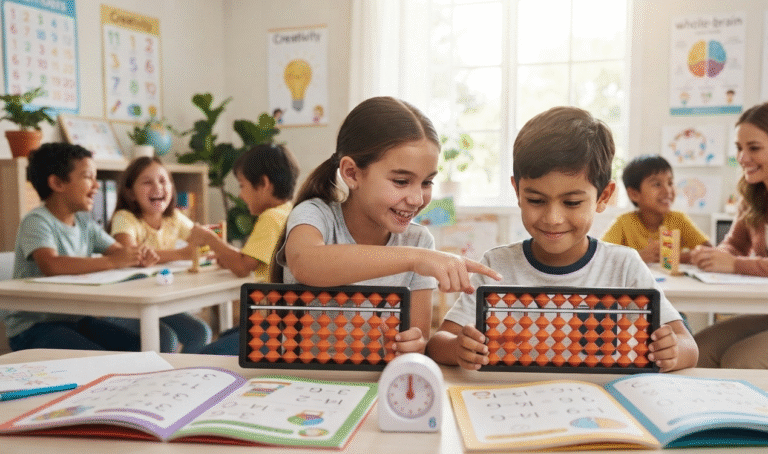
Abacus lessons take place in small groups where children work together, support each other, and even participate in friendly competitions. This element of socialization makes for great motivation for children who often try to go further just because their friends are doing the same thing next to them.
How to Choose the Right Abacus Program for Your Child
If you feel prepared to start with the abacus class, there are several tips to consider:
- Choose a fun approach in teaching. Good programs make use of play, stories, and positive reinforcement instead of stress or practice.
- Consider the class size. Small classes tend to provide more personal attention for kids.
- Inquire into the process of monitoring progress. A good program should reward small victories throughout the learning process.
- Listen to your child’s reactions. If he or she is enthusiastic about sharing newly acquired skills with you, then it is probably a good choice.
A Gentle Note for Parents
Each kid will learn his or her own special way, and it is perfectly fine. For abacus lessons to be effective, they need to be light, fun, and without pressure; therefore, it is essential to select lessons that will include a lot of fun, stories, and motivation, but no drilling exercises.
Abacus math isn’t about solving problems faster—it is about giving children the gift of a happy, positive attitude towards mathematics from an early age. If learning is made to feel like playing, kids aren’t only going to improve in arithmetic but will become focused, curious, and very confident learners overall.
So if your child is ready for a fun and exciting challenge, the abacus lesson may very well be the perfect choice!