
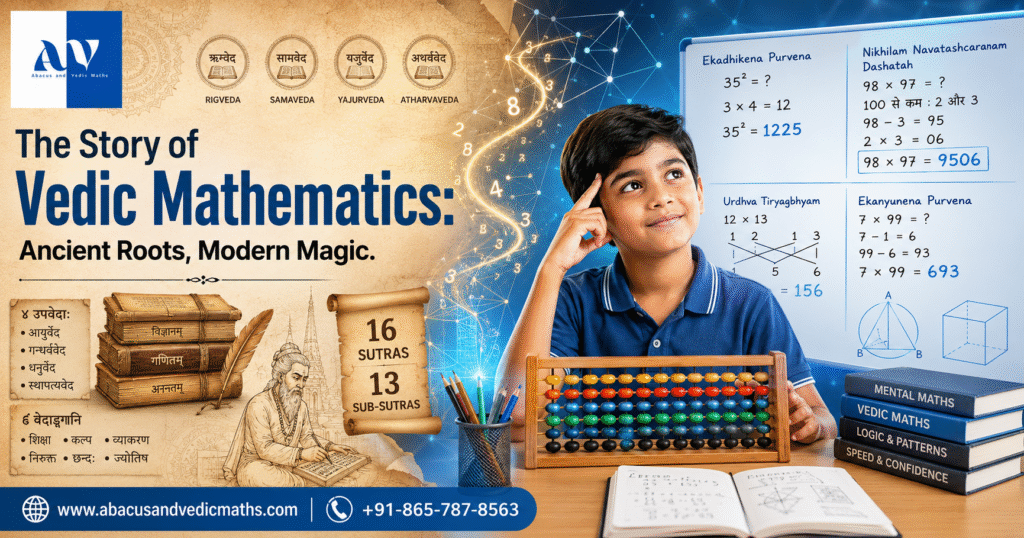
The Story of Vedic Mathematics: Ancient Roots, Modern Magic
It’s possible that you’ve seen some individuals multiplying large numbers in their heads really quickly and others using a calculator. Vedic mathematics is often the key to solving the more difficult problems that appear; it’s a mental math system that makes long and complex problems simple and easy. This is a set of 16 Sutras and 13 sub-Sutras. They will assist you in solving your sums related to arithmetic, algebra, and geometry. This is the point where you must know about the history of Vedic Maths, its origin, its working, and why it is used even today.
A Quick Look at the Vedas!
The word is a result of understanding the Vedas. These are the most ancient knowledge systems of Indian tradition. There are four of them—Rigveda, Samaveda, Yajurveda, and Atharvaveda. These are more akin to anthologies of hymns, chants, rituals, and philosophical reflections and ideas than books. Carefully transmitted orally for centuries and now written. In addition, there is an Upaveda to each Veda, with its Upaveda being an application of knowledge area where the Veda’s wisdom is used.

Each of these Vedas has an Upaveda, an offshoot of application that applies the knowledge contained therein to practical ends:
Veda | Upaveda | Area of knowledge |
Rigveda | Ayurveda | Medicine, anatomy, health |
Samaveda | Gandharvaveda | Music and sound |
Yajurveda | Dhanurveda | Archery and warfare strategy |
Atharvaveda | Sthapatyaveda | Architecture, engineering, and mathematics |
Another six Vedangas, or the “limbs” of the Vedas, are there too. They include topics such as grammar, astronomy, and word meanings. They used to explain to people the correct interpretation and application of the Vedic texts along with him.
Vedic can be defined as being derived from the Sanskrit word “Veda” (meaning knowledge/wisdom). Vedic may also refer to the Vedic Period (thought to be 1500–500 B.C.). Between this period, Indian thinkers contributed to the geometry (in the rules of building the altar called the Sulba Sutras), to the number system, and to astronomy. Vedic Mathematics is traditionally associated with Sthapatyaveda (Upaveda of the Atharvaveda), related to architecture and geometry and numbers.
Who Gave Us Vedic Mathematics?
Behind the system of today lies the work of Jagadguru Swami Sri Bharati Krishna Tirthaji Maharaj (1884–1960), the Shankaracharya of Puri’s Govardhana Matha.
Tirthaji was also a very knowledgeable Sanskrit scholar, philosopher, and mathematician. Early in his academic career he was a top performer in a number of subjects, winning many awards. He claimed himself to have studied the ancient texts for years and meditated on them. In this way he found 16 sutras that contained quick and elegant ways of performing calculations. These are what he termed as “rediscovery of knowledge from the Atharvaveda tradition of the ancient Indian sages.”
He became well known to the rest of the world in 1965 with the publication of his book Vedic Mathematics, which was published a few years after his death. It has since been translated, taught, and adapted worldwide and has been a source of inspiration for many teachers, authors, and training programs in other countries.
Let's Look at How the Sutras Work: The Main Idea
Typically, the normal math taught in the schools teaches one way of solving each type of problem, and the same method is used to solve them all, irrespective of the numbers themselves. Vedic mathematics is different—one has to consider the numbers first and then select the most efficient method. If a number is near 100, then you employ one of them. If it does not end in 5, then use another. This is what makes mental calculations feel natural and not like doing a robot. This is the fourth in a series of sutras that you can attempt today. Here’s a look at some of the reasons for the popularity of the system.
- Ekadhikena Purvena, or “By one more than the previous one.”
This Sutra is very easy to use when squaring numbers that end in 5. Start with the first digit (3), and multiply by one more than the first digit (which is 4) to get 12. Then, finish off with 25 at the end. The answer is 1225.
Try it: For 65 squared, you do 6 times 7, which is 42. So the answer is 4225.
- Nikhilam Navatashcaramam Dashatah (all from 9 and the last from 10)
For numbers near 100, you will have to know how far away from 100 each number is (2 and 3) to get the product of 98 x 97. Then you find the difference between the diagonals: 98 – 3 = 95. Now you find the product of the two differences: 2 x 3 = 6. Finally, you put it all together to get 9506.
It also works for numbers that are above the base. In the case of 103 times 104, the numbers are 3 and 4 above 100. You add diagonally: 103 + 4 = 107. You find the product of the differences: 3 x 4 = 12. The result is 10712.
- Vertically and crosswise, #3
This is a multiplication method that can be used for any numbers. To multiply 12 by 13:
- First, you multiply the digits on the left: 1 x 1 = 1.
- Cross multiply and add: 1 x 3 + 2 x 1 = 5.
- Now you multiply the digits on the right: 2 x 3 = 6.
- Put them together: 156.
The pattern can be extended to multiply larger numbers, such as 3-digit numbers.
- Ekanyunena Purvena (“By one less than the previous one”)
This Sutra will be useful to multiply numbers such as 9, 99, 999, and so on. The left part is 7 – 1 = 6; this is the number that will be created as a result of multiplying 7 by 99. The right-hand side is 49 – 6 = 43, but since the middle numbers are missing, it’s 99 – 6 = 93. Combine them: 693. No need to do long multiplication – it’s a few simple steps that you can do in your head.
An Honest Note on Its Origins
The telling of a story is a good one to be accurate. Rudolf G. F. Stevens claims that the basis of Vedic mathematics is simpler than that of the conventional methods, while the historians and mathematicians have different opinions regarding its origin. However, no reference to the Sutras exists in any Vedic manuscript, and many scholars believe that it is a modern invention by Tirthaji and not a method that was passed on from ancient times.
The techniques are effective, no matter what your opinion is. They are mathematically correct and develop number sense, confidence, and quickness. Hence, they are still prevalent in classrooms and learning centers even today.
Why Learn Vedic Maths?
- Speed: Many computations turn into a few simple calculations in one’s head.
- Confidence: Students who are lacking in their confidence in maths begin to enjoy maths.
- Mental calculation is a brain workout, and it will help you to focus and remember more.
- Exam advantage: It provides competitive exams with less time.
- Cross-checking: These built-in features enable you to check the correctness of the solutions as quickly as possible.
- Number sense: Understanding that these patterns in numbers help them to understand “how” math works, rather than “how to follow steps.”
- Fun: Shortcuts are like discoveries—which makes practice something children look forward to.
Tips to Get Started
- Begin small. Study one Sutra at a time and practice it in a way that it becomes automatic.
- Practice daily. Fifteen minutes a day is much quicker than long periods of time from time to time.
- You know your tables. Efficient times tables up to 10 make all of the shortcuts easier.
- Check your answers. Verify your answer with another method or an estimation.
- Make it a game. Run with a friend, or against the clock!
FAQs
What is Vedic Mathematics ?
Vedic Mathematics is a Mental Mathematic based on Sixteen Sutra’s and Thirteen Sub-Sutra’s. The problems can be solved easily and quickly in arithmetic, algebra, and geometry using these short formulas instead of conventional formulas.
Who developed Vedic Mathematics?
Jagadguru Swami Sri Bharati Krishna Tirthaji Maharaj formulated the current system (1884-1960). He was also the Shankaracharya of Govardhana Matha at Puri. He published his book, Vedic Mathematics, in 1965.
Is Vedic Mathematics truly from the ancient Vedas?
This is debated. The story of the sutras begins with Tirthaji, who said he had rediscovered them from the Atharvaveda tradition. There is a catch, though. Here’s the thing about the sutras: nobody can point to them in any known Vedic text. Many scholars think the whole system was put together in modern times. Believe whichever story you like. The methods work either way. They are mathematically correct and can be of great use in everyday life.
At what age should children start learning Vedic Maths?
Most children could start at around 8 or 9, when they know their addition and subtraction and multiplication tables. But there’s no age limit. Older students and adults can learn it too, because the shortcuts help with exams, with work, and with day-to-day calculation.
Is there any replacement of school maths with Vedic math?
No. It supports the learning taking place at school. Conventional methods lay the foundation, while Vedic methods provide the students with quicker alternatives and methods to validate their answers.
What are the differences between Vedic Maths and Abacus training?
In Abacus training, students develop visual and finger skills in calculation, typically with younger students, through the use of a frame of beads, either actually or imagined. Vedic Maths is based on formulas and patterns of numbers to obtain solutions in a quick way. The two are complementary to each other—Abacus creates speed and concentration, and Vedic Maths provides flexible strategies.
Will Vedic Maths be helpful for competitive exams?
Useful for time-saving questions involving the calculation of problems like multiplication, squares, percentages, and approximations. When there is a good understanding of the concept, then it will work best with the help of shortcuts, as they will help most of the time when the concepts are understood.
What are the principals of learning?
You can read through a sutra in one sitting. Making it automatic takes longer. The techniques get automatic after a month or two of using them every day for about 10 to 15 minutes.
Do I need to be strong in arithmetic to learn Vedic math?
No. Students that feel pressured while solving standard math problems report when using Vedic methods that numbers are much friendlier as a result of shorter steps and more recognizable patterns.
Is Vedic Maths able to solve all kind of problems?
It has particularly high strength in the area of arithmetic, as well as many topics in algebra and geometry. There are certain Sutras that are more appropriate for specific types of numbers than others, and the ability is to select the applicable Sutra to solve each problem.
Final Thoughts
While the concept of Vedic Mathematics may be open for discussion by some historians, there can be no doubting its usefulness in the classroom. Numbers become play things, and with just a few Sutras under your belt, coupled with some practice each day, it won’t take long before math seems more like a game than anything else.
Are you ready to start learning? Check out our Abacus and Vedic Math courses today.