
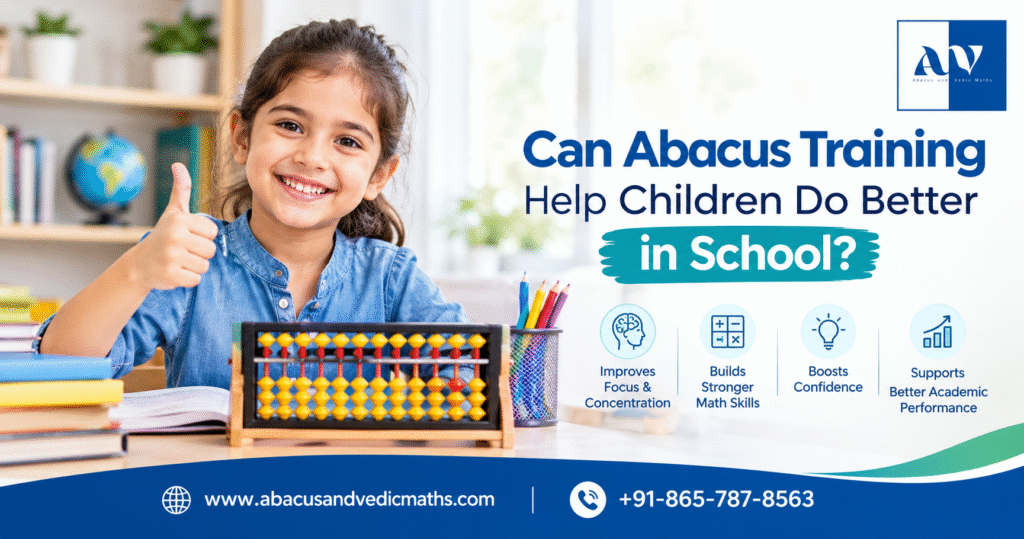
Can Abacus Training Help Children Do Better in School?
Every parent wants to give their child a genuine edge—not just in exam scores, but in how confidently they think. That’s exactly why abacus training has been quietly making a comeback among parents looking for something more than rote memorization. Built on visualization and mental arithmetic, it doesn’t just teach children what to calculate—it teaches them how to think about numbers, and that shift tends to show up everywhere, not just in the math notebook.
At Abacus & Vedic Maths, we take this a step further by helping children build a genuine visual picture of every problem they solve. Once a child can “see” a calculation in their mind, something wonderful happens—they start thinking, analyzing, and calculating at a speed that often surprises even their own parents.
With abacus training centers and online programs both growing in popularity, it’s worth asking the obvious question: does any of this actually help in school? Let’s walk through how our program is structured, what it involves day to day, and the real benefits it brings to a child’s academic life.
How Our Program Is Built
Our Abacus program is structured according to modules that correspond to age-based stages and are supported by learning methods that are based on the way children really learn. As opposed to focusing directly on speed, we start out with a series of steps that combine visualization with tactile exercises that tend to improve concentration, memorization, and accuracy.
Live Instructor-Led Sessions
Our experienced teachers conduct stimulating and interactive abacus classes, which have been formulated into eight distinct levels according to the syllabus of abacus worldwide. The first step starts with kids manipulating the physical beads, doing calculations, and moving on to doing calculations without the actual abacus by visualizing its mental image.
This method not only provides consistency in the process of learning for a child but also keeps the process fun and light. The trainers make use of peer learning, friendly competitions, and storytelling in order to keep the child entertained.
Wherever this format has been used, educators consistently report longer attention spans, stronger math performance, and sharper logical reasoning in students.
Practice Portal — Learning That Continues at Home
Learning inside the classroom does not complete the learning process; for that reason, we developed the Practice Portal, where children can reinforce their lessons through tests, videos, and courses anytime they want. There are no time limits or pressures.
The portal includes:
Module-specific practice sets
Animated video demonstrations
Speed-building challenges
Progress tracking for both kids and parents to follow along
It’s especially handy during school holidays or for catching up after a missed session—learning simply continues, uninterrupted.
Parents Are Part of the Journey Too
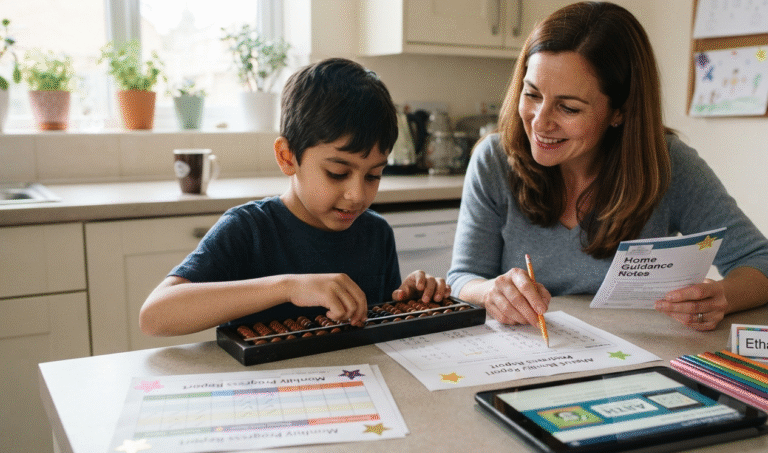
No learning program truly succeeds without support at home, which is why we bring parents into the process from day one. Through orientation sessions, we walk parents through our approach, what results to expect, and—just as importantly—how they can support their child’s growth outside the classroom.
Here’s how parents typically stay involved:
- Encouraging consistent use of the practice portal at home
- Following along with monthly progress reports
- Joining parent-teacher check-ins to track development
- Cheering their child on during practice challenges and friendly contests
We also provide practice worksheets and simple home-guidance notes, because a little encouragement at the kitchen table goes a long way. When parents and instructors work as a team, children tend to feel more supported—and that support shows up in their confidence and results.
The Real Benefits of Abacus Training
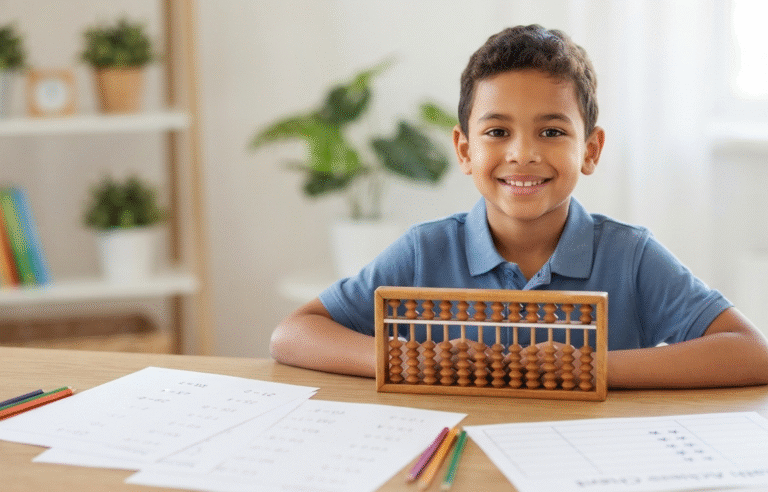
When abacus coaching becomes part of a child’s routine, the payoff reaches well beyond math class:
Faster Calculations — Children trained in mental visualization techniques often calculate noticeably faster than their peers, sometimes several times over.
Sharper Attentiveness — The multi-sensory, hands-on nature of abacus practice naturally improves focus and cuts down on careless mistakes.
Growing Confidence—As math becomes easier, that confidence has a way of spilling into other subjects too.
Improved Memory—With regular practice, the learner acquires the ability not only to remember faster but also to work memory, which is helpful in more ways than simply calculating.
Increased Academic Achievement – Regardless of their class, learners who practice regularly demonstrate some level of improvement in their mathematics tests.
Reduced Mathematics Anxiety—Since the activity appears to be a fun game for the children, they form a healthy attitude towards figures.
The advantages are more important to the learner at elementary and middle school levels when the basics of mathematics are developed.
Bringing Abacus Training Into Schools
We collaborate with the schools to incorporate structured abacus lessons right into the classroom setting so that they fit in seamlessly along with the usual academic lessons. Teachers find that the common result of introducing the program in their classrooms is an improved ability to concentrate in classes, enhanced accuracy in mental calculations, and a more positive attitude towards the subject altogether. The students become more active participants in class discussions, and this newfound sense of self-assurance extends to problem-solving in other subjects too.
It serves as a testament to the idea that there lies more mathematical ability in each child than what a textbook is able to provide him with.
Growing Beyond Math with Abacus Training
Abacus training is a proven method of helping the development of the entire brain, and manipulation of the beads is not the end of it. It improves memory, enhances concentration, and develops logical thinking and problem-solving skills.
The lessons at Abacus & Vedic Maths focus on much more than developing techniques for mental calculations. Each and every course is carefully crafted so that it is balanced, age-appropriate, and fun.
Regardless of whether your child is good at taking online classes or likes going to the classroom environment better or would prefer some combination of the two, we have everything you need. Each lesson is specifically tailored to help your kid grow in his or her own rhythm.
After completing an abacus program, many children demonstrate achievements that are not limited to mathematics—increased confidence, improved academic performance in general, and a thirst for knowledge. All of these qualities will benefit your child all throughout life.
Schedule a demo class today.
FAQs
Q1: What is the right age to teach someone the usage of an abacus?
Individuals who are aged between 4 years and 14 years are eligible to learn the usage of an abacus, but the best age group would be 6 to 10 years.
Q2: What does an abacus course cost?
Course fees vary depending on the format—online or offline, and group batch or one-on-one sessions. Reach out to us for a plan that fits your child’s needs.
Q3: Can kids learn abacus online?
Absolutely—our Online Interactive Live Training and Practice Portal makes it easy for children to learn abacus effectively from home.
Q4: Do schools need special infrastructure to offer abacus instruction?
Not at all. We provide certified instructors, complete training manuals, and all necessary materials—schools don’t need any specialized setup.
Question 5: How long does the abacus course last?
This course may vary in duration depending on the pace of the kid and the levels that he goes through. However, the duration of each level takes three months.
Q6: Why should children be taught abacus?
It helps to improve mental arithmetic, concentration, memory skills, and visualization skills as well.
Q7: Can students who already do well in school still benefit from abacus training?
Definitely. Even high-performing students gain an edge—abacus training sharpens mental agility, improves accuracy, and strengthens memory and concentration, helping them tackle increasingly challenging math and reasoning problems with ease.