
Vedic Maths or Abacus? Your Complete Guide to Choosing the Right Math Method for Your Child
Each parent has the exact desire to see a child feel at ease with numbers and not frightened by their numbers. It’s a challenge to figure out the best way to reach that goal, and with each of Abacus along with Vedic Maths widely recommended, it can be difficult to decide between the two.
This is the best part: it’s not necessary to select which is the “better” one, because there’s not one. Abacus and Vedic Maths have been designed for different ages, various learning styles, and frequently, distinct stages of the same journey through math. This guide will walk you through each fully—including how they function in their own unique way, the reasons they’re different, which one is best for your child’s age, and what you need to do to determine which is best for your kid. In the end you’ll know a precise positive answer, rather than an uneasy one.
What Is Abacus?
Imagine a box made out of wood with countless beads that slide up and down within rods. That’s the abacus. It’s one of the oldest tools for calculating around as well as one of the most efficient ways to develop a child’s ability to recognize numbers today.
Every rod on the abacus symbolizes a specific number of values: The center rod represents one of the “ones” places (the unit indicator). The rod on its left is the tens of a hundred, and then the hundreds after that as well, and on. The beads themselves are organized in two sections: upper and lower. Each bead slide becomes an unnoticeable process of subtraction, adding, or multiplication.
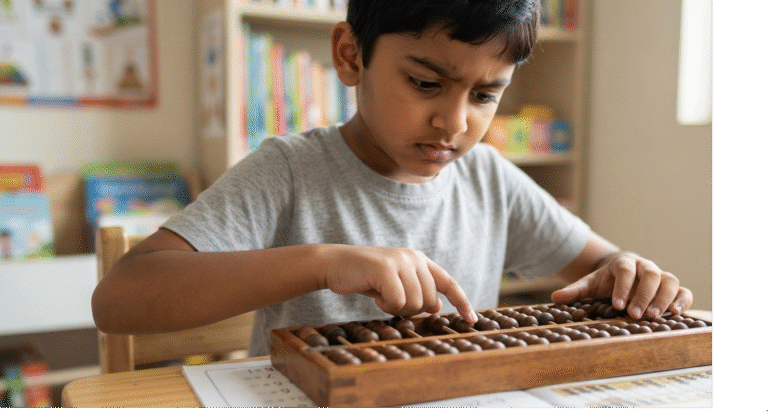
Most people believe the abacus is nothing more than a mathematical aid that can make you fast in doing arithmetic calculations. It’s true, but it’s only the tip of the iceberg. What really happens is beneath the surface. When kids move their beads around and make maths in their minds, it engages their senses of touch and sight as well. Multisensory learning will help develop better concentration and a true 360-degree brain development that goes beyond calculating faster numbers.
What Is Vedic Mathematics?

The concept of Vedic Math has its origin in Atharvaveda, which is one of the four Vedas written in ancient times (the other three being the Rigveda, Yajurveda, and Samaveda). As per the legend, it was believed by the people in ancient times that answers to all practical questions of life were hidden in the Vedas, including mathematics.
The Vedic Maths system we have as is being rediscovered between the years 1911 and 1918 through the Shri Bharati Krishna Tirtha Maharaj (1884-1960), who is popularly called the founder of modern Vedic Mathematics, who codified the Rigveda and these ancient methods into a logical system based upon 16 sutras (formulas) as well as 13 sub-sutras.
What makes Vedic Maths so appealing is how well it streamlines computations that normally require many steps and quite a lot of time. It covers a surprisingly broad spectrum of topics, including algebra, trigonometry, and arithmetic, as well as coordinate geometry, that are all handled with the pure logic of structured logic, instead of memorizing processes. A lot of kids (and truthfully, a lot of adults too) go from the idea of “I’m just not a math person” to “Wait, that was actually easy.”
How Each Method Actually Works
How Abacus Learning Works
The Abacus curriculum is based on levels, starting exactly the way you’d think: easy multi-digit subtraction and one-digit addition. As it progresses, it progresses towards division, multiplication, and multi-digit math and always in a way that’s compatible with the child’s level of comfort.
It’s truly remarkable: as children progress in their development, they no longer require the physical instrument altogether. Within a matter of a few minutes, a child who has been trained can think of solving 10 rows of math problems without a pen or calculator on the table. Test it yourself.
2 + 2 + 5 – 4 + 2 – 7 + 9 – 4
An abacus-trained child, Abacus, is able to work through the sequence of numbers such as this in a matter of seconds and not due to their basic mathematical ability suddenly increasing; however, their focus and processing of information have been sharpened over many months of repetition.
How Vedic Maths Works
The basic principles of Vedic Maths include four that govern this system:
Sutras (Formulas): Sutras (Formulas) form the main sutras along with 13 sub-sutras that make addition, multiplication, subtraction, division, and even quadratics easy mental tasks.
Mental Math—Calculations are made within the mind, either with or without paper and pen, and help develop a real fluency in numbers and not rely on written instructions.
An Integrated Approach Each sutra breaks down a complicated issue into easy steps that make daunting problems appear manageable.
Broad Application—The techniques are applicable to the fields of algebra and arithmetic as well as geometry and calculus.
Here’s an example that we like for you to observe in action. You can try to solve this with no calculator.
100000 – 34257
A lot of borrowing often frightens kids to the wall. If you apply this Vedic sutra “All from 9 and the last from 10,” it is surprisingly straightforward:
10 9 9 9 9
– 3 4 2 5 7
———–
6 5 7 4 2
If you take the preceding digit of the highest digit of place value before subtracting, the entire process is reduced to a couple of simple steps—that are solvable within a matter of seconds and no effort necessary.
Benefits of Abacus Learning
Whole-Brain Development: Abacus practice is a dual-handed practice wherein one hand is used to move the beads while another writes down the answer. The dual actions stimulate both brain sides simultaneously and are an important factor in a well-rounded development.
Really Improved Concentration: It is difficult to impart this specifically, particularly for young youngsters who struggle to be still in yoga or meditation. The training with the abacus builds it in a different direction because it is so stimulating; concentration becomes a natural result.
Three Senses Working Together: Three Senses, Working Together activities involve sight (visualizing the instrument) as well as hearing (listening to the numbers and asking questions) as well as touching (moving beads) simultaneously. This multisensory involvement is what makes abacus a good practice for intense focus and endurance of the brain.
Improved Visualization and Recall: When children imagine bead places in their heads, they improve their capacity to remember visual information fast and with accuracy. This skill will benefit them well beyond math classes.
A faster, more structured calculation: Learners of the abacus discover how to divide large tasks into manageable, smaller steps. This habit can be applied to any academic discipline, not only arithmetic.
Benefits of Vedic Maths
Accelerate Calculations—By simplifying maths through old systematic methods, Vedic Maths can make calculations in the mind much faster and more efficient.
Higher Accuracy—Because the way in which problems are approached is regular mental processes, smaller mistakes that can be found in lengthy calculations are far more rare.
Reduced Math Anxiety It’s a great feeling of confidence to be confident in working through a challenge quickly. This small victory, which is often repeated, eliminates math anxiety and is replaced by a rational and positive mindset.
More Enhanced Pattern Recognition Vedic Maths helps children recognize patterns in numbers, which makes solving problems more intuitive and enhances logic thinking throughout.
Better Problem Breakdown: Complex problems are broken down into easy, sequential steps, which sharpens thinking skills that go beyond the mathematical notebook.
Improved Logical Reasoning Skills As numerous sutras provide multiple methods to arrive at the same conclusion The children are taught to think in ways that are flexible and can compare methods rather than following one method.
More Analytical Thinking As time passes, the brain develops the ability to judge and resolve problems quickly and rationally. It’s an ability that assists in all subjects the child is studying, including math, but not just math.
Ideal Age for Each
Abacus: It’s best to start between 4 and 12 years. There’s not a strict limit on age; however, the ideal age is the early age—between the ages of 4 and 12. When children’s brains respond beautifully to the abacus’s multisensory aspect, it also helps improve cognitive abilities, motor skills, and the all-important habit of concentration.
Vedic Maths: Most effective when started around 8+ years old. Vedic math tends to click most effectively when a child has developed a fundamental knowledge of the basics of math, usually from the age of 8 or so. This is when children have the ability to comprehend the reasoning behind sutras instead of simply learning the specific steps.
It’s important to remember that the difference between children who do very well in math and the one that struggles most frequently isn’t really about skill in any way; it’s more about math fear. When an individual of a particular age group, who has been afraid of math all his life, says, “Hold on, that was easy!” after being a participant in a Vedic Maths class, there is definitely going to be some kind of a change. The individual’s curiosity about math gets piqued after taking the class, and the fear vanishes completely.
Cognitive Impact & Academic Impact
Abacus
Develops a strong mental (near-photographic) memory via bead visualization
Enhances multitasking skills via simultaneous mental steps
Develops confidence in the numbers through making it seem natural
It provides a solid foundation for fundamental math
Increases the accuracy and focus span, especially in the first academic year.
A lot of people use it as a fundamental building tool for learners in the early years.
Vedic Maths
Increases the speed of mental calculation through sutra-based techniques
It encourages the development of analytical thinking as well as logical reasoning
Enhances memory recall and improves general mental flexibility
It is applicable to a variety of subjects, including division, multiplication, algebra, and more.
Significantly increases both speed of calculation and accuracy
Relieves anxiety about math by making difficult calculations appear easy
Abacus vs. Vedic Maths Comparison
Feature | Abacus | Vedic Maths |
Tool Used | Beads and abacuses are used to create a physical object. | Tools are not required; it’s done completely by the brain. |
Method | The movement of beads represents numbers. | The ancient sutras can be used as mental shortcuts to help you remember the past. (formulas) |
Ideal Age Group | Children in the early years (4-12 years old) | Children who are older (8 and over) |
Focus Area | Basic concepts: addition, subtraction, multiplication, and division. | More broad: arithmetic, algebra, square root, and many more |
Learning Style | The tactile and the visual (hands as well as eyes) | Conceptual and mental (memory as well as logic) |
Speed Development | Created through the use of bead visualization | Constructed using direct mental calculation methods |
Memory Benefits | Increases the memory of vision and improves concentration | Improves mental flexibility and increases number sense |
Time to Build Fluency | About 2 years to achieve proficiency across all different levels | About 6-12 months for solid foundational proficiency |
Cultural Origin | China and East Asia | Ancient India |
Main Advantage | Enhances brain development, visualization, and focus | Enhances speed of calculation, trust, and logic |
A Few Honest Limitations of Each
The best method doesn’t work for each child. Hence, it’s important to set real expectations.
Abacus
- To master it completely takes time—generally a few years of steady, level-by-level training
- Needs strong vision skills that some children require longer to master.
- More closely aligned with particular techniques taught in high-grade mathematics classes in schools.
Vedic Maths
- This can be extremely difficult, particularly for infants that haven’t yet developed the basic sense of numbers
- It’s not always the same method used in the textbooks at school This can lead to additional explanations at the home
- Without any concept, the sutras might turn out to be merely a process of rote learning rather than actual knowledge.
So, which one do you choose?
Here I will tell you the truth without any doubt: there is no competition whatsoever between Abacus and Vedic mathematics.
They’re designed for the different levels of a child’s mathematical learning journey, not separate “teams.” It all comes down to the child’s age, the way they learn, and the goals you’re trying to achieve the foundation for.
- When your kid is still young (4-7 years old) and you are looking to develop their focus and visualization and a real fascination with numbers by engaging them in active play, begin with Abacus.
- If your child is 8+ years old and has basic math skills but requires more speed, confidence, and the ability to overcome the fear of math, Vedic Maths is likely more appropriate for them.
- For many families, they work perfectly together. Abacus forms the basis of cognitive and sensory learning at first, and then comes Vedic Maths, which forms the upper part of the child’s mathematics education.
Tips for Getting Started
Do you want to let your child experience abacus and Vedic mathematics? Some simple steps will go a long way to having a fun and enjoyable learning experience:
- Start with the basics. Start by teaching the basics, and allow your child to build on to more complicated ideas naturally. There’s no reason to hurry.
- Choose the best instructor. A well-trained, patient teacher can make an enormous difference in the way children experience these techniques Look for courses that have certified and experienced teachers.
- Do it continuously. A few minutes daily might prove to be sufficient for achieving some significant improvement in just two months. What really matters is consistency and not long-term exercises.
FAQs
Are Abacus and Vedic Maths the best for my kid?
There’s no “all the time” “better”—it depends on the child’s age and the skills you’re working to improve. Abacus is an excellent option for kids who are young (4-12), as it helps to develop focus and visualization. Vedic math can be chosen by kids above 8 years of age, as this technique will help in building efficiency and logic.
Is it possible for a single child to be an expert at using both the abacus and Vedic mathematics?
Yes, there are children who can use the two methods. Generally, they start by learning the use of the abacus when they are young and then move on to Vedic Maths as they grow up.
What is the time frame to begin seeing the outcomes?
If using an abacus, noticeable progress is typically visible after just a few months. Attained mastery usually occurs in 2 to three years, at various levels. Vedic Maths typically shows visible outcomes faster, typically after six to twelve months of consistent education.
Are these methods in line with the curriculum my child learns in the school?
They are used in conjunction with math in schools, but they’re not designed as a substitute for the subject. They can help develop number consciousness in addition to the ability to perform tasks with speed and make school-based techniques easier to comprehend, even if they may differ from textbooks utilized at schools.
Does my child need to have a knack for maths in order to gain?
Not at all. In fact, children who have anxiety or are unsure regarding math tend to benefit most from these strategies. They are made to boost confidence and alleviate fears of math in a sequential method, no matter where your child’s learning journey starts.
Are you ready to decide what is the most suitable route option for your kid?
Take a look at the choices for you to consider, which include online Abacuscourses along with online Vedic Maths classes. Request the free demo from one of our expert tutors for personalized guidance in accordance with your child’s age as well as the way they learn.