
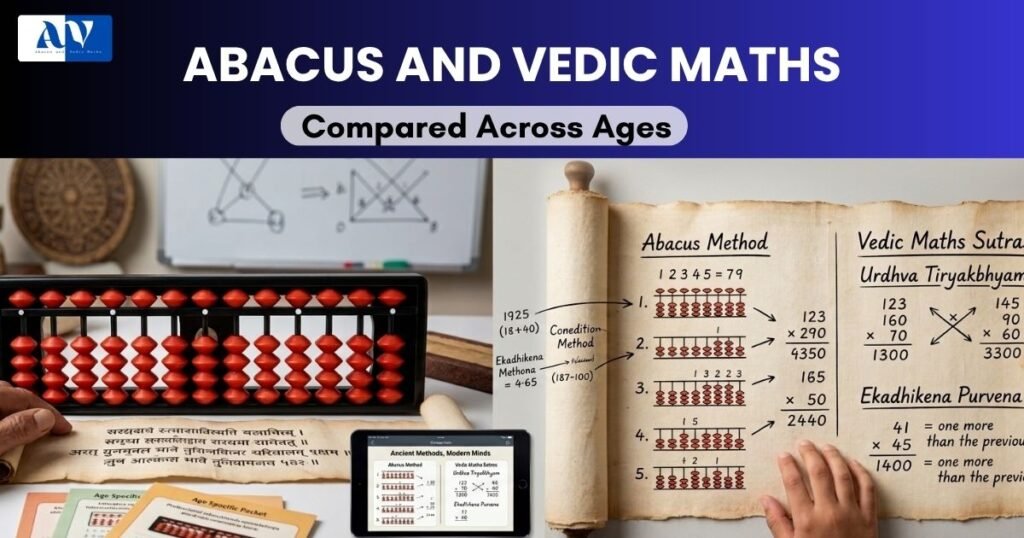
Right now, schoolwork feels tougher than ever, so moms and dads look for smart ways to help kids think faster. Online Abacus training appears frequently these days, alongside Vedic Maths – both strong choices. Questions arise: which works better, and when should a young learner begin either path?
Each method brings unique benefits, and together they build a solid foundation for learning that lasts. Whether searching for abacus classes nearby, live virtual sessions, or Vedic Maths programs for children, knowing which suits which age group is crucial for better results.
A fresh look at learning tools begins here, offering side-by-side comparisons, practical examples, and real gains observed in children. One Mumbai-based program stands out, shaping skills through daily practice and smart routines. Step by step, progress becomes visible, thanks to consistent training and thoughtful design.
Abacus and Vedic Maths Explained
Picture a row of sliding beads quietly shaping young minds. With practice, kids start visualizing the abacus mentally – no physical tool needed. This mental imagery sharpens memory, attention, and rapid thinking.
Vedic Maths, on the other hand, uses ancient techniques to simplify tough math problems. It builds problem-solving skills, quick calculations, and step-by-step reasoning. Both methods aim to strengthen thinking, but they do so through different approaches.
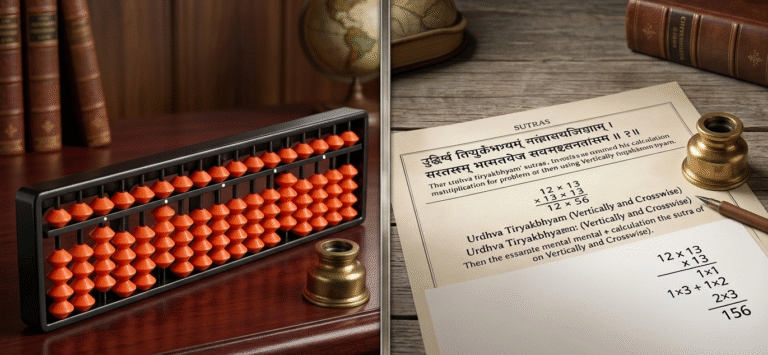
Abacus Compared With Vedic Maths By Age Group
| Age Group | Abacus Benefits | Vedic Maths Benefits | How It Helps |
|---|---|---|---|
|
4–6 Years |
Develops basic number recognition and motor skills
|
Not recommended at this age
|
Early number play shapes focus; counting feels like a game |
|
6–8 Years
|
Enhances visualization and memory
|
Introduces simple number patterns
|
Strengthens brain development and learning ability
|
|
8–10 Years |
Improves mental calculation and focus |
Teaches calculation shortcuts
|
Math work becomes smoother, faster, and more accurate
|
|
10–12 Years
|
Strengthens advanced mental calculations
|
Introduces faster problem-solving techniques
|
Less stress in tests; answers come quicker; room to check mistakes
|
|
12–14 Years
|
Moves fast without losing precision
|
Mastery of advanced shortcuts and algebraic thinking
|
Boosts confidence and academic performance
|
|
14+ Years
|
Gains are smaller but routine-linked
|
Useful for competitive exams and timed challenges
|
Faster problem-solving, stronger thinking, steady confidence
|
Abacus Helps Kids With Numbers
Many parents wonder if an abacus truly benefits children. The answer is a clear yes. Mental math exercises both left and right brain areas, boosting cognitive growth, especially in young kids.
Abacus online training improves:
- Calculation speed and accuracy
- Memory power
- Concentration
- Visualization skills
- Confidence
Most children joining virtual abacus lessons notice improvement in school performance within months. Math skills strengthen, focus sharpens, and confidence grows quietly in other subjects too.
Abacus Usefulness for Children
Beyond math, abacus learning supports overall cognitive development. Children who learn abacus:
- Perform faster calculations without calculators
- Focus better in studies
- Develop strong cognitive abilities
- Gain confidence in problem-solving
Parents can choose between nearby abacus classes or online lessons for smooth, convenient learning. Some find it works out smoother that way.
Abacus vs Vedic Maths: Key Differences
| Benefit Area | Abacus Helps Children Learn Math Skills | Vedic Maths Helps Students Think Faster |
|---|---|---|
|
Calculation Speed
|
Fast mental calculation using visualization
|
Shortcut formulas for quick problem-solving
|
|
Accuracy in Maths |
Reduces errors through step-by-step learning
|
Increases accuracy with simplified methods
|
|
Brain Development |
Activates both hemispheres for balanced growth
|
Enhances logical and analytical thinking
|
|
Memory Improvement |
Strengthens memory through visualization
|
Helps retain formulas and calculation patterns
|
|
Concentration & Focus
|
Daily practice gradually improves focus
|
Attention sharpens while tackling tough challenges
|
|
Problem-Solving Skills
|
Builds basic problem-solving abilities
|
Enhances advanced logical thinking
|
|
Confidence in Maths |
Boosts confidence through mastery
|
Reduces fear of math using easy techniques
|
|
Learning Age Suitability
|
Best for 5–14 years |
Ideal for 9+ years; test preparation
|
|
Application in Exams |
Speeds up basic calculations
|
Saves time in competitive exams
|
|
Ease of Learning
|
Simple, visual, and engaging |
Quick to learn with formula-based tricks
|
|
Long-Term Benefits
|
Improves overall academic performance
|
Supports advanced learning and test prep
|
Understanding Abacus Levels
Step by step, abacus learning unfolds in clear phases, helping kids grow their abilities slowly yet steadily. A steady rhythm shapes each lesson, making sure young minds gain confidence along the way.
Fingers start to move beads across wires, a quiet rhythm building dexterity along with early number sense. Small shifts train hands just as much as they shape thinking about digits.
After that comes number work, where kids sharpen their skills by doing sums again and again. Mistakes fade as they go, slowly building confidence through steady effort.
With time, learners begin using mental images of the abacus, shaping how they solve problems inside their heads. Moving forward, practice shifts toward seeing numbers as pictures, helping thought-based math grow stronger. Instead of relying on blocks, pupils start imagining each step, building confidence through silent rehearsal. Gradually, inner vision takes over, letting calculation happen without touch. Later stages lean into this quiet focus, replacing movement with mind-eye coordination. Through repetition, invisible beads become familiar, almost real in thought alone.
Over time, doing it regularly builds both quickness and precision, getting kids ready for harder math tasks ahead. Faster here, slower there – every child flows through the steps in their own way at AV Abacus and Vedic Maths Academy.
Learning sticks better when it feels right for them. What fits one won’t always suit another, so timing shifts freely. The result?
Steady progress without pressure, shaped by how each student actually learns.
Abacus Meets Vedic Maths
Combining abacus and Vedic Maths enhances results. Daily practice strengthens speed, accuracy, and confidence.
Key benefits include:
- Mental calculation improves
- Errors reduce gradually
- Quick thinking grows naturally
- Problem-solving becomes easier
Learning math feels like a game. Curiosity and joy coexist with structured practice. Kids develop strong learning skills for the next academic challenges.
Abacus Classes Nearby Compared to Online Options
Looking for abacus classes nearby? Virtual sessions work just as well.
Online Abacus Classes Benefits:
- Learn from home
- Flexible timing
- Access to expert trainers
- Interactive and safe sessions
At AV, Abacus and Vedic Maths Academy Online, lively online lessons feel more like play than study. Children enjoy math while curiosity drives learning.
AV Abacus and Vedic Maths Academy, Mumbai
A solid start begins where learning feels natural. A different kind of learning lives here, where teachers move step by step with learners, shaping clarity in thought along with ease in math. Progress shows up softly, through lessons that make sense, piece by steady piece.
Little by little, children go through every part of the abacus method at their own pace, growing skills naturally. Since class feels more like a game, attention stays high—understanding takes root when it comes alive.
Busy days? Online classes fit seamlessly into your family’s routine. Since every kid moves at their own speed, personal help keeps up without rushing ahead. Brain growth isn’t just about grades—it shapes thinking too. With care tailored to individuals, kids build skill alongside self-assurance.
A single step at a time, every kid picks up real math know-how along with tools for daily challenges, slowly forming a base that lasts through years of school ahead.
When to Begin Abacus and Vedic Maths
Younger minds start abacus around five, though some wait till seven. Nine marks a shift – this is when Vedic math begins fitting into learning routines. Timing shapes how well each method sticks. Beginning too early or late, the gains shrink without notice. Right moment means a stronger grasp; the wrong one brings quiet setbacks.
Supporting Your Child’s Growth: Final Thoughts
Speed of thought is essential, even if report cards dominate attention. Abacus wakes up multiple brain areas; Vedic Maths trains thinking under pressure. One builds foundation, the other accelerates problem-solving – both reshape learning quietly but effectively.
Well-structured courses, whether online or nearby, ensure children grow at their own pace. AV Abacus and Vedic Maths Academy, Mumbai offers programs that help kids develop skills steadily, building confidence, focus, and academic success.
Start now to help your child grow stronger in math and acquire quick thinking skills. With skilled coaches guiding the way, lively sessions mix with personal support to build real progress. Kids learn clearly, stay engaged, naturally gaining confidence that carries into class – and life after it.