
What Is the Right Age to Start Abacus Learning for Kids?
Each parent has to ask this question earlier or later: “When is the right time to start a skill program for my child?” When it comes to the abacus, the answer to “when” matters just as important as the response, “what.” “If you can get the timing right to ensure that you’re not instructing a child on how to compute but you’re actually capturing their brains at precisely the time when it’s the most keen to learn.
This is the best part: children don’t see the concept of “training.” For them, it appears as beads, colors, and games, as well as the tiny thrill of getting an answer quickly. However, beneath all that fun there’s something incredibly taking place—decades of study and experience in the classroom demonstrate that children’s brains are open to developing concentration, memory, and the ability to recognize numbers. It’s almost as if the brain is awaiting precisely this type of activity.
We at Abacus & Vedic Maths believe that the concept of the entire Online Abacus Class program is built on beginning children at the right age and with the correct approach so that learning becomes fun long before it is like math. Let us discover what “the right age” is all about, what it implies, how it is very important, and how your little one will benefit from getting started on time.
Introducing the Abacus: The Math Learning Toy
Imagine a wooden frame that has rows of colorful beads moving down rods, segregated into sets of tens. It’s called the Soroban, or Japanese Abacus. And it’s the standard of gold used across the globe in all abacus-related programs and even ours.
The thing that makes it unique isn’t its tool but what goes on in a child’s imagination during the use of it. Every slide transforms into a tiny bit of subtraction, addition, or multiplication; the numbers cease to be abstract squiggles that appear on the page and turn into something children are able to see and feel. If you practice enough, there is something that seems almost magical as children begin “seeing” the abacus in their minds and begin to calculate with it without having it before them in any way.
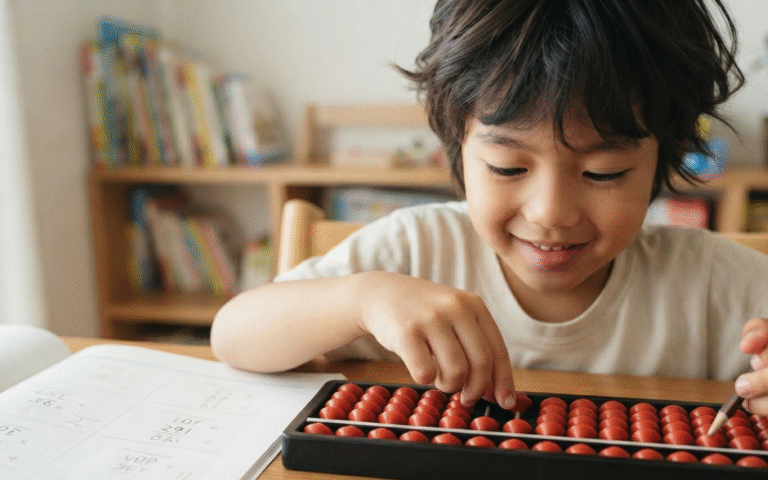
This is known as a mental abacus. Watching the child perform it for the very first moment—doing a multi-digit calculation within their heads, with fingers twitching like the beads are still there—it is truly a joy to watch.
It is the tool that will help you make a difference:
- The Soroban—Japanese Abacus
- Interactive tools for the virtual abacus on our online e-learning portal
- Visualization games and flashcards
- Games-based, fun practice sessions that will keep children coming to the next session
Why Timing Makes All the Difference
There’s a fact worth remembering. Between the ages of 10, the brain of a child is extremely plastic and very open to learning connections and new habits quickly. Introduce abacus learning in this time frame so that you don’t have to fight an uphill fight. It’s all about the grain of the way a brain that is young naturally would like to expand.
Children born in the same time period tend to grow:
- More focused and more attention durations
- Greater listening skills and better visualization
- A keen, early sense of patterns and sequences of numbers
- Hand-eye coordination is improved due to the constant hand-on work with beads
The best part is that these benefits aren’t limited to math lessons. Parents frequently tell us that the child’s calmer, more attentive during their homework, and more apt to take on new interests. Since learning is a process of games and little wins, children also begin connecting problem solving with enthusiasm and confidence, not anxiety. This is a way of life that slowly can pay dividends for the rest of their lives.
Well, What Is the Ideal Age?

As you think about how to determine the cut-off age, there is something that both experts on children’s development and teachers agree on, namely, 4 to 7 years old.
This is the reasoning behind it. It’s as simple as
- At around age 4, kids begin to recognize the numbers of objects and count, which is the ideal launchpad to learn about abacuses.
- When they reach age 7, they’re prepared to tackle somewhat more intricate math and can follow instructions for multi-steps confidently.
- The time frame of this program also provides ample room to make progress that is organized, level-by-level, and enough time to develop real proficiency well before middle school.
That’s precisely why our curriculum is structured to be structured in this way in the first place: a gentle toddler. Level that is aimed at ages 4 to 5 to be followed by Abacus levels 1 to 8 for those who are 4 or older Each level is a part of an uninterrupted 90 days. Explore the entire course by visiting our Online Abacus Class page.
The Joy (and Benefits) of Starting Early
As abacus education is initiated at a young time, it no longer becomes “just math” and becomes an entire thing that builds confidence, which is evident in every aspect of the life of a child.
- A Fantastic Whole-Brain Workout Abacus exercise is two-handed. One hand is used to move the beads, while the other writes the answer, stimulating both brains all at once. This is a basic practice with an unexpectedly high reward to develop a balanced, holistic brain.
- Concentration that comes naturally It can be difficult to get a child to remain still during yoga or meditation, which can be an actual challenge. But give them a bunch of beads, and give them a challenging task to work on, and concentration will manifest itself by itself. Abacus training sneaks concentration-building into something that already feels like play.
- A Memory that Keeps Growing More Accurate The pattern repetition and number games that are incorporated into the abacus game help to strengthen the auditory and visual memory as time passes. This is the type of increase in memory that goes beyond math classes.
- A focus that is a constant companion for them everywhere Children who have been trained in the abacus have the same sharpened focus in their hobbies, sports, and daily tasks—more than just numbers.
- Acceleration and Precision That feels like superpowers. With consistent repetition, mental math will become an automatic process. It’s a truly happy moment for a child when they can solve a math problem faster than the parent could pull out their phone.
- It’s a learning experience that is like playing Each and Every Time. The numbers become an unending game; with a few victories along the way, students remain interested, enthusiastic, and—most importantly—looking at their classes with anticipation.
The Takeaway
In an age that values fast, confident thinking, the abacus program gives kids an advantage in their thinking—that is why starting in the correct time, which is between the ages of 7 and 4, is what makes that head start really worth it. It improves mental math skills, improves focus, and creates the foundation for lifelong solving skills, at the same time feeling more fun as a task.
In Abacus & Vedic Maths, we’ve created our course to meet this specific need that includes levels specifically designed for children and youngsters with instructor-led live sessions and real-time tracking of progress and a course designed for children to be happy right from the first day of class.
Get a free demo by speaking to one of our tutors, who are experts, to learn the way the online abacus classes are shaped to your child’s age and the stage of their development.
FAQs
- What is the best abacus for children? Abacus for kids?
Japanese Soroban is considered to be the most popular choice for kids, easy and user-friendly, and the basis of the majority of modern curricula in abacus, such as ours.
- How long would it take for you to learn the basics of an abacus?
The program is composed of 9 separate stages, each lasting for 90 days, and consists of 2 classes in a week. Most kids see rapid development within the first few months, which then progresses level by level.
- How can I get two-year-olds to grasp the concept of numbers?
As they get older, keep it fun—number recognition and rhymes, as well as the tactile experience of beads or other counting toys, work. Abacus-related formal training should be reserved until children are four or 4.5 years old. That is at the point that our toddler level (ages 4-5) commences.
- Does my child have the opportunity to learn about Abacus on the internet?
Absolutely. The live classes we offer online are run via a dedicated portal for e-learning featuring real-time streaming video as well as instructor-led guidance and the ability to track progress—which makes the online experience just as enjoyable and efficient as a live course.
- What is the sign that my child is prepared to go on?
If your child’s ability to make a count of 1-20 or more, they should sit for about 15 minutes and follow easy instructions, and then they’re all set to start.
- Can abacus-based learning help only in math?
Not even close. It’s not rooted in mathematics. Abacus instruction helps build the ability to focus, confidence, and problem-solving abilities that are apparent across every topic—as well as every day living.
- Is abacus training stressful for young kids?
If it’s done properly. Our curriculum is built around little rewards as well as a pace that’s age-appropriate; children are able to truly enjoy the process without feeling pressured.