
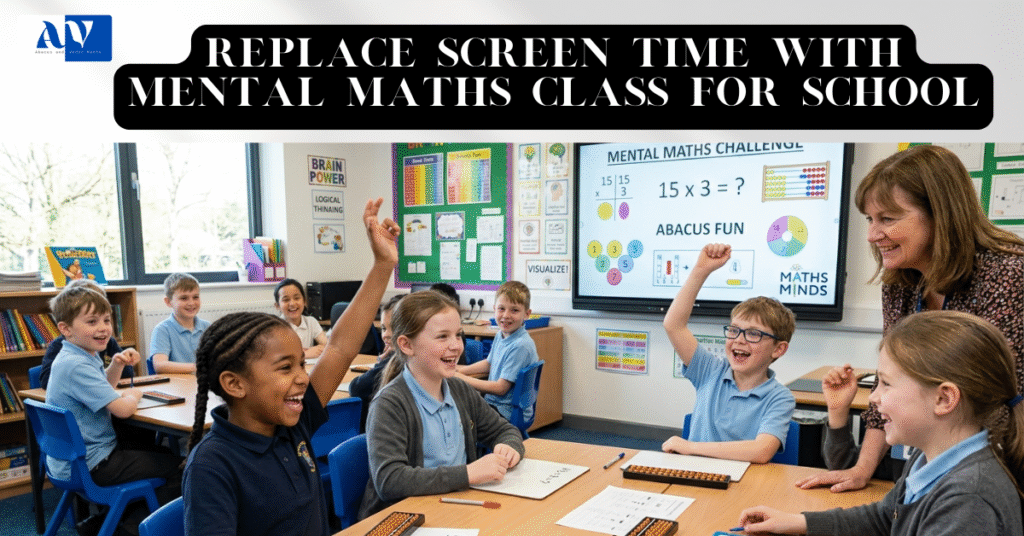
In the modern educational system, schools are no longer teaching to memorize and test in writing. A need to educate students with quick thinking, logical solving and real-life application of mathematics with confidence. It’s here that a mental maths class for school has a tremendous impact on a child’s cognitive skills.
Mental maths course online is not limited to working out arithmetic answers in the head. A systematic training of concentration, memory, visualization and logical thinking. Mental maths training allows pupils to be more confident tackling numbers, quicker calculating and more efficient in their learning. Modern mental Mathematics training is being adopted by schools and students with the help of interactive learning systems and training programs by platforms like Abacus and Vedic Maths.
Mental Maths Class for School: Learning to Calculate Using the Mind
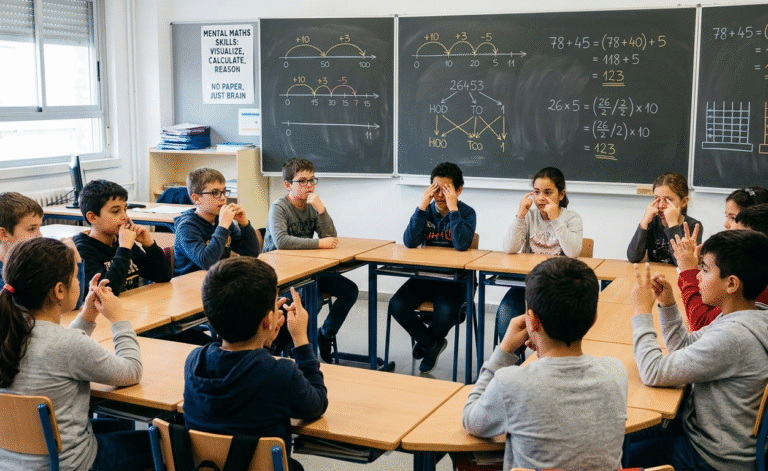
A mental maths class for school is a learning class for calculation skills that does not use paper, pen or a calculator. Instead, pupils are taught to picture numbers and to use systematic, efficient, and accurate strategies for mental calculations.
The classes focus on building brain skills and are not just about memorizing formulas. Students develop skills to decompose problems into their smaller components, and to solve them in a timely manner with logical reasoning.
Typical elements of mental maths lessons are:
- Rapid methods of addition and subtraction
- Multiplication shortcuts
- Division strategies
- Number visualization exercises
- Pattern recognition activities
- Memory strengthening drills
- Speed-based problem solving
This systematic training enables students to build solid mathematical skills at an early stage.
Why Mental Maths Classes for Kids are More Important than Screens?
Children spend a considerable time on smartphones, tablets and computers in today’s digital world. Technology can aid learning, but too much of the wrong thing like YouTube videos, mobile games, and social media can be a replacement for learning activities involving brain power. When children are enrolled in a mental maths class at school it becomes really significant.
There is a significant difference between how a child’s brain develops over time when learning maths vs engaging with digital passive entertainment.
Mental Maths Classes vs Screen Time Activities
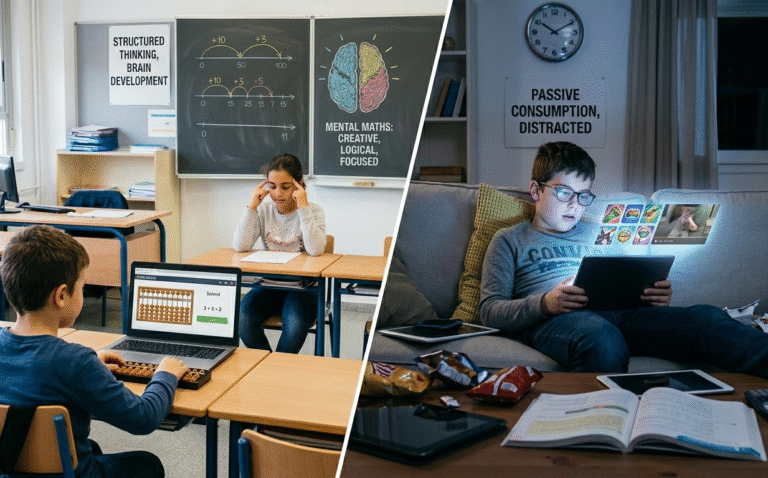
For mental maths classes, the focus is on building active thinking
- Promotes creative, logical thinking
- Focuses and concentrates well using planned activities
- Improves memory with visualization
- Increases speed calculation and study ability
- Develops a sense of discipline and mental stamina
- Practices both sides of brain with regular practice
YouTube, Games, and Passive Screen Time are associated with passive consumption
- Breaks the concentration and focus of the child as they are constantly switching content
- Loses concentration and patience with time
- Promotes reliance on sight to keep them entertained and engaged
- Prevents students from engaging in deep thinking and problem-solving practice
- Spends too much time on distractions, lessens motivation to study
- May disrupt sleep and school schedule
Key Difference in Brain Development
Brain development involves structured thinking, which is developed through mental maths training; and entertainment-based screen time mostly keeps the brain passive. If children continually consume content without thinking, it will be difficult for them to apply their minds to academic tasks over the long term.
Conversely, consistent application to a mental maths context enhances pupils’ thinking processes and their ability to apply these in learning and out of learning, reinforcing their learning and performance.
Impact on Children’s Lives Over Time
Children spending longer in structured learning activities, such as Mental Maths classes demonstrate:
- Higher academic confidence
- Better problem-solving ability
- Stronger attention span
- Improved memory retention
- Increased autonomy in learning
In the meantime, too much screen time, particularly free time, can be linked to:
- Lower level of concentration in studies
- Lower academic motivation
- Issues with complex tasks
- Reduced patience and persistence
It is not the technology that’s the issue, it’s the usage. Children’s thinking and learning capacity increases greatly when they are directed towards systems of productive learning rather than passive entertainment, such as mental maths.
Hence, online programs such as those from Abacus & Vedic Maths are gaining popularity. They offer structured learning which supports children to move out of the “screen culture” and develop their thinking and skills which will be useful in life.
Why Mental Maths is Important for School Students
Traditional calculation methods are important for school students and frequently become a difficulty for them in their mathematics learning. With mental maths, the brain is trained naturally and automatically to calculate with numbers.
A good mental maths lesson, in school, will enable students to:
- Promote attention and attention span
- Increase calculation speed
- Strengthen memory retention
- Minimize fear of mathematics
- Develop logical reasoning skills
- Develop confidence in exams
Students start to experience mathematics as a fun subject and not a stressful subject through regular practice. They also are more likely to participate in class and to engage in problem-solving tasks.
How Mental Maths Helps to Improve Brain Development
Mental maths is well known to be a great brain development tool. Activates the left (and right) hemisphere of the brain by using visualization and structured thinking exercises.
Students develop mental imagery of numbers, mental computation and better memory for things. This helps to reinforce neural connections and enhance cognitive function with time.
Here are some of the key brain benefits that can be expected:
- Enhanced attention span
- Better working memory
- Faster information processing
- Improved visualization ability
- Stronger analytical thinking
They are applicable to mathematics, and also to the study of science, logic, and making day-to-day choices.
The Importance of Abacus & Vedic Maths in Mental Maths Training
The best mental maths learning is when Abacus and Vedic Maths are used in conjunction. Abacus & Vedic Maths offers structured programs using all these powerful tools to boost student learning, including mental arithmetic training.
Abacus training enables students to practice, understand and visualize the movements of beads in their mind, and Vedic Maths methodology introduces some tricks for performing calculations in a faster manner. These two will make good preparation for Mental Arithmetic skills.
This multipurpose approach has the following benefits:
- Faster calculation abilities
- Strong visualization skills
- Better problem-solving skills in terms of accuracy
- Better number sense
- Help pupils gain confidence in maths
The combination is particularly beneficial for students in schools who are taking competitive exams or aiming to boost their overall academic performance.
Technology in Mental Maths Classes
No more traditional classroom based mental maths programs are in the past. Students have access to online learning platforms that provide interactive learning experiences that make learning more interesting and effective using digital platforms.
Today’s mental maths class in school may contain:
- Interactive, live online classes
- Worksheets and practice modules in digital format
- Visual learning tools
- Performance tracking systems
- The ability to be assessed and given feedback on a regular basis
- Flexible learning schedules
With this techno driven approach, students learn at their own pace with proper guidance from the experienced trainers.
Reasons Why Mental Maths is Useful for School Students
Learners benefit from mental maths training for their long-term learning and cognition.
Improved Number Sense
Students gain a natural appreciation for numbers, which helps them make confident estimates, comparisons, and analyses of quantities. This builds an intuitive understanding of mathematics that develops gradually through regular practice.
Enhanced Visualization Ability
Numbers begin to take shape in the mind when mental math is practiced regularly. This quiet exercise builds awareness of calculations without written support. Thinking speed improves as patterns become easier to recognize through repetition. Imagination strengthens through consistent internal practice. Cognitive clarity replaces earlier confusion. A calm and steady focus develops over time.
Better Decision-Making Skills
When under pressure, learners solve problems mentally, which builds quick judgment through silent calculation. Choices become faster as hesitation reduces. Accuracy improves during timed situations. Efficiency develops through consistent mental practice. Students learn to respond with clarity in challenging moments.
Reduced Dependence on Rote Learning
Students focus on understanding patterns and logic instead of memorizing steps. Learning becomes deeper, more meaningful, and more flexible. Concepts are retained longer because they are understood rather than repeated mechanically. This strengthens overall mathematical thinking.
Improved Problem Decomposition Skills
Breaking down problems becomes a natural part of learning. Complex tasks are divided into smaller, manageable steps. This allows students to focus on one part at a time. Structured thinking develops gradually through practice. Clarity improves as large problems become simpler components. Each step builds toward complete understanding.
Improved Attention to Detail
Attention improves when tasks require precision and careful thinking. Focus becomes sharper as students work through calculations step by step. Accuracy increases through steady practice. Small details become easier to notice and correct. Performance improves as consistency develops over time.
Mental Discipline is Developed
Regular practice builds consistency, patience, and structured thinking habits. Students learn to stay focused for longer periods. This strengthens self-control and supports long-term academic growth. Discipline develops naturally through repeated mental effort.
Improved Exam Time Management
Exams become less stressful as mental calculation skills improve. Thinking becomes faster and more organized under time limits. Students complete tasks more efficiently and with greater confidence. Time is managed better through quick reasoning. This allows space for review and reduces exam pressure.
Mental Maths in the AI Era for Future-Ready Students
In this age of AI, technology can be used to do calculations in an instant, but it can’t do the thinking, reasoning and making decisions that humans do. For school students it is even more crucial that they master mental maths.
Students who have a solid foundation in mental maths will develop in their ability to:
- Critical thinking skills
- Logical reasoning ability
- Fast decision-making skills
- Problem-solving confidence
- Independent thinking habits
Despite the advancements of AI, students who possess excellent mental abilities will never be outdone as they can analyse, interpret and apply knowledge effectively.
Flexible Learning for School Students
Flexibility is one of the greatest benefits of contemporary Mental Maths classes. Students can learn without having to miss their school day nor their after-school programs.
This is especially beneficial for:
- Primary school students
- Middle school learners
- Competitive exam aspirants
- Homeschool students
- Busy academic schedules
Flexible learning provides opportunities for each student to develop good mental skills at a pace that is suitable for them.
More Than Just Mental Maths Training
Early growth in mental math quietly shapes how a child engages with schoolwork, influencing self-assurance, attention span, and thought processes. With steady guidance and repeated exercises, learners begin to process ideas more swiftly, respond with greater precision, silently refine logic patterns – skills that transfer well beyond mathematics. Given current classroom demands, such sharpened thinking has shifted from being helpful to simply necessary.
Here, Abacus and Vedic Maths builds understanding using web-based mental math sessions. Through dynamic instruction, skilled educators guide learners – offering adaptable schedules so study fits home life without losing clear direction or routine. Engagement grows naturally when lessons focus on progress, shaping quicker thinking, sharper attention, plus self-assurance over time. Structure supports growth; results emerge quietly through consistent effort.
With digital learning methods now linked to time-tested calculation strategies, Abacus & Vedic Maths helps learners develop clear reasoning skills. Academic progress grows stronger when these approaches work together. Clarity of thought emerges through structured practice. Success in school becomes more achievable under such conditions. Thinking that adapts to new challenges forms gradually here. Tools matter less than how they are used over time. Results appear not suddenly, but step by step.