
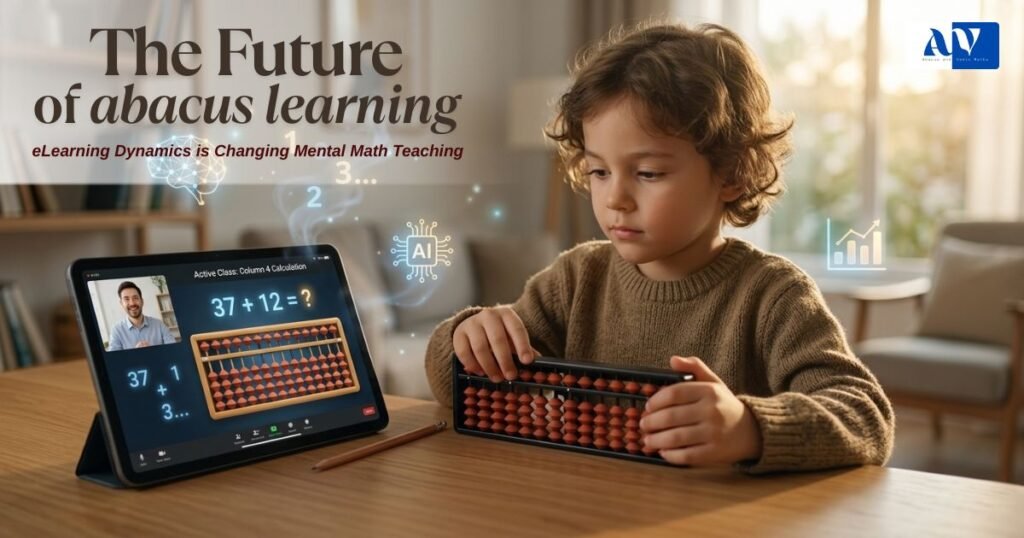
The Future of Abacus Learning: eLearning Dynamics is Changing Mental Math Teaching
Education is in a fast-changing world, and learning the use of abacus is not an exception. What was once confined to physical classrooms and manual methods that were cumbersome and expensive has now been transformed into a powerful digital ecosystem powered by innovation, accessibility, and smart learning systems.
The current generation of learners requires a personalized approach to education, more flexibility, and interactive learning methods. This has played a key role in the way abacus and Vedic mathematics are being taught globally, especially through online platforms such as Abacus & Vedic Maths.
Modern digital learning is no longer just about teaching, it is about building advanced learning environments that respond to each student’s pace, capability, and development through adaptive learning systems.
The Digital Transformation of Abacus Education
Traditional abacus teaching emphasized physical instruction, repetition, and memorization. Although highly effective, it lacked flexibility and scalability.
With the rise of eLearning systems, abacus education has now entered a new era where students can learn anytime, anywhere through well-structured online platforms.
Key transformations include:
- Shift from in-person classrooms to internet-based learning
- Increased access to global abacus learning programs
- Flexible student learning schedules
- Integration of interactive learning tools
- Real-time performance tracking and feedback
This transformation has made abacus learning more inclusive for students of different ages and skill levels.
The Importance of Technology in Modern Abacus Learning

Technology has become one of the most powerful drivers improving the delivery of abacus education. Modern online platforms now use advanced systems to enhance engagement and strengthen learning outcomes.
The most widely used abacus learning tools include:
- Digital abacus simulators
- Interactive practice modules
- Video-based guided lessons
- Automated performance tracking
- AI-supported learning recommendations
These tools help students visualize mathematical operations more effectively, improving both speed and accuracy in mental calculations.
At Abacus and Vedic Maths, these innovations support a blended learning approach that combines traditional teaching with modern digital tools.
Personalized Learning for Stronger Mathematical Development
Every student learns differently, and mastering abacus skills requires consistent practice and structured learning. Modern eLearning systems now offer highly personalized learning experiences.
Personalized abacus learning includes:
- Adaptive difficulty levels
- Customized learning paths
- Individual progress tracking
- Smart revision recommendations
- Performance-based lesson adjustments
This ensures that students are neither overburdened nor under-challenged, but instead progress at an optimal pace suited to their abilities.
Personalized learning also enhances confidence, concentration, and long-term understanding of mathematical concepts.
Engagement and Gamification in Abacus Training
Gamification is one of the strongest trends in modern education, using game-based elements to make learning more engaging and motivating.
It is particularly effective in abacus education because it encourages consistent practice and faster improvement in calculation speed.
Common gamification methods include:
- Reward points systems
- Timed calculation challenges
- Level-based progression
- Achievement badges
- Competitive leader boards
These elements make learning more enjoyable while significantly improving mental math speed and accuracy.
Students are more motivated to practice regularly, which is essential for mastering abacus skills effectively.
Mobile Learning and Flexible Education
With mobile devices becoming an essential part of daily life, abacus learning has become more accessible than ever before.
Mobile platforms allow students to study anytime and anywhere, whether at home, during travel, or between school tasks.
Benefits of mobile learning include:
- Anytime access to lessons
- Flexible study schedules
- Offline practice options
- Easy progress tracking
- Smart device-to-device learning
This is especially beneficial for young learners who perform better with short, consistent practice sessions rather than long study hours.
Modern abacus learning platforms rely heavily on data analytics to track student performance and improve learning outcomes.
These systems monitor:
- Calculation speed improvements
- Accuracy levels
- Practice consistency
- Learning progress over time
- Areas requiring improvement
This data helps teachers and parents clearly understand a student’s strengths and weaknesses.
With this approach, data-driven education systems ensure continuous improvement and more effective learning strategies.

Interactive learning has become a core part of modern abacus education. Instead of passive learning, students now actively participate in digital classrooms.
Interactive features include:
- Live online classes
- Real-time quizzes and exercises
- Virtual abacus simulations
- Audio-visual explanations
- Student-teacher interaction tools
These features increase engagement and improve understanding through active participation rather than passive observation.
Virtual classrooms also allow students from different regions to learn together in shared learning environments.
Artificial intelligence is playing an increasingly important role in enhancing learning experiences. In abacus education, AI helps personalize instruction and improve student outcomes.
AI supports abacus learning by:
- Identifying learning gaps
- Recommending practice exercises
- Tracking performance trends
- Automatically adjusting difficulty levels
- Providing instant feedback
This ensures every student receives a unique learning experience aligned with their individual progress.
AI also reduces teacher workload, allowing educators to focus more on mentoring and skill development.
One of the greatest advantages of digital education is accessibility. Abacus learning can now reach students regardless of location or learning ability.
Modern platforms support:
- Multi-language learning support
- Voice-assisted learning tools
- Special learning support features
- Flexible learning schedules
- Remote course access
This increases inclusiveness and ensures every student can develop strong mental math skills.

The future of abacus education is closely linked with continued advancements in digital learning technologies. As platforms become smarter, learning experiences will become even more personalized and immersive.
Future trends may include:
- AI-powered adaptive learning systems
- Virtual reality-based abacus classrooms
- Real-time cognitive performance tracking
- Emotion-based learning adjustments
- Fully automated learning paths
These innovations will further enhance abacus education and elevate mental math training to a new level.
Abacus learning is undergoing a major transformation driven by digital innovation and evolving eLearning trends. The combination of technology, personalization, and interactive methods is reshaping how students develop mental math skills.
Platforms like Abacus and Vedic Maths are at the forefront of this change, combining traditional abacus methods with modern learning systems to deliver a more effective and engaging learning experience.
As education continues to evolve, abacus learning will remain a powerful tool for improving concentration, memory, and mathematical ability, now strengthened by the vast possibilities of digital learning.